In this guide
This article explains where a UGV, autopilot console or fertigation system earns its place.
Equipment
Not every job belongs in the air. Orchard rows, tractor guidance and fertigation are ground-layer jobs that determine how well the aerial work fits the farm.
Quick answer
Ground equipment complements the aircraft. The P150 carries 70 kg in the air; the R150 works the rows it cannot reach. The FPDI fertigation pump runs 2.5 m³/h, the APC2 autopilot holds ±2.5 cm, and installation is typically about 20 minutes on a compatible machine.
In this guide
This article explains where a UGV, autopilot console or fertigation system earns its place.
UGV
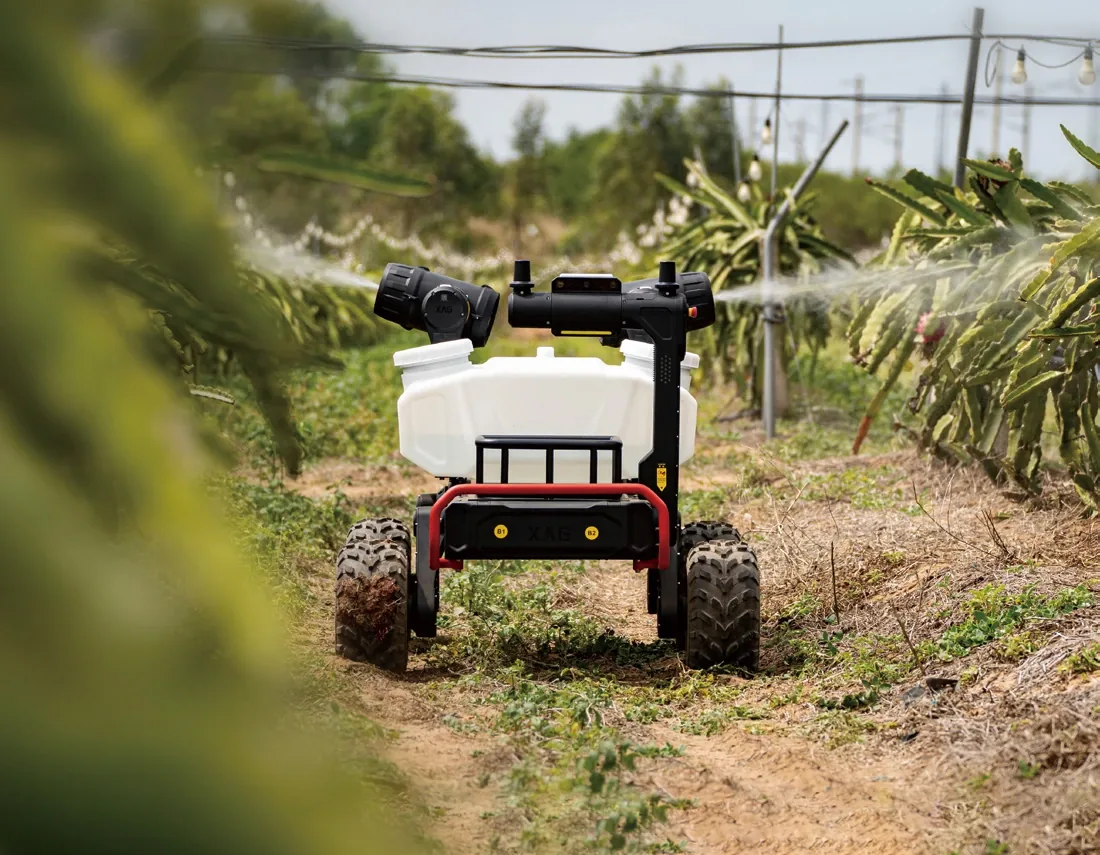
Dense orchard rows, low canopies and confined spaces are difficult for an aircraft to cover evenly. A ground robot carries the spray closer to the target and can work when wind would ground the aircraft.
The trade-off is speed and access. A UGV is slower than an aircraft and needs a drivable route; it complements the aircraft, it does not replace it on broadacre.
Autopilot
An autopilot console brings centimetre-level guidance to tillage, seeding and fertilizer passes. The benefit is reduced overlap, less driver fatigue and a repeatable line.
Installation is typically around 20 minutes on a compatible machine. Confirm the vehicle model, correction source and implement offset before ordering.
Fertigation
Valves and injectors turn irrigation into a measured, scheduled input. The value is dose control and records, not just remote switching.
A smart valve handles pressure and flow; a pump-driven injector doses with feedback; a pressure-differential injector suits simpler installations.
| Equipment | Job | Typical fit |
|---|---|---|
| UGV | Orchard row spraying | Dense canopy, confined rows |
| Autopilot | Tractor guidance | Tillage, seeding, fertilizer |
| Smart valve | Irrigation control | Scheduling and pressure |
| Injector | Nutrient dosing | Fertigation with feedback |
Integration
The aircraft maps the block; the tractor uses the boundary; the ground robot uses the rows; the fertigation system uses the zones. The value comes from sharing the same field data, not from buying three isolated tools.
Checklist
Key takeaways
Related guides
Most agricultural drone comparisons start with payload. That is the wrong first question. The right first question is: which job do you need to repeat, on which blocks, with what support?
MappingRTK is often listed as a feature without explaining what it depends on. The correction source decides whether centimetre accuracy is available in your field.
BuyingA commercial drone quotation can look simple: aircraft, batteries, charger. The differences that decide the total cost are usually outside that list — guidance, spare parts, training, export terms and support.
Next step
Tell us the rows, tractors and irrigation setup. We will propose the ground equipment that fits.