Spraying drones
Spraying Drone — Crop Sprayer, Payload and Coverage
A spraying drone is not just a tank with rotors. Coverage depends on droplet size, flow rate, flight height, speed and the airflow that carries the droplet into the canopy. Change one and the result changes.
Quick answer
A spraying drone applies crop protection products from the air using a pump, nozzles and airflow. The XAG P150 carries a 70 L tank, sprays up to 30 L/min with a 5–10 m swath and 60–400 µm droplets. P60 is the compact option. We supply both factory-direct.
Overview
This page covers how the system works, how to estimate coverage, what to check in a configuration, and where aerial spraying fits against tractors and manual application.
Specifications
System specifications
P150 spraying
- Liquid tank
- 70 L
- Maximum flow
- 30 L/min
- Effective spray width
- 5–10 m
- Droplet size
- 60–400 µm
- Spray system
- XAG RevoSpray 4
P150 platform
- Maximum payload
- 70 kg
- Aircraft weight
- 54 kg with spray system and batteries
- Protection rating
- IPX6K
- Maximum speed
- 18 m/s
- Hovering precision
- RTK ±10 cm
Safety and sensing
- Radar
- 4D imaging, beamforming
- Sensing range
- 1.5–100 m
- Obstacle avoidance
- 2.5 m
- Field of view
- ±40° horizontal; +90° to −45° vertical
- Operating temperature
- 0–40 °C
Supply
- Models
- XAG P150 / P60
- Nozzle and droplet setup
- Configured per crop and product
- Training
- Operator and technician training
- Spare parts
- Genuine parts through the authorized network
- Delivery and order size
- Tailored to your order
How it works
Pump, nozzles, airflow and route
The pump moves product from the tank to the nozzles. The nozzle and pressure set the droplet spectrum. The rotors create airflow that helps carry droplets into the canopy. The route determines overlap and missed strips.
The practical result is a system: you cannot judge a spraying drone by tank size alone. Ask for the flow, swath, droplet range, speed and RTK accuracy together.
- Pump and flow rate: how much product leaves the tank per minute.
- Nozzle and droplet size: how the spray behaves in the canopy and wind.
- Swath and route: how many passes and how much overlap.
- Height and speed: how the airflow and coverage interact.
- RTK and radar: how repeatable and safe the pass is.
Coverage
How many hectares per hour?
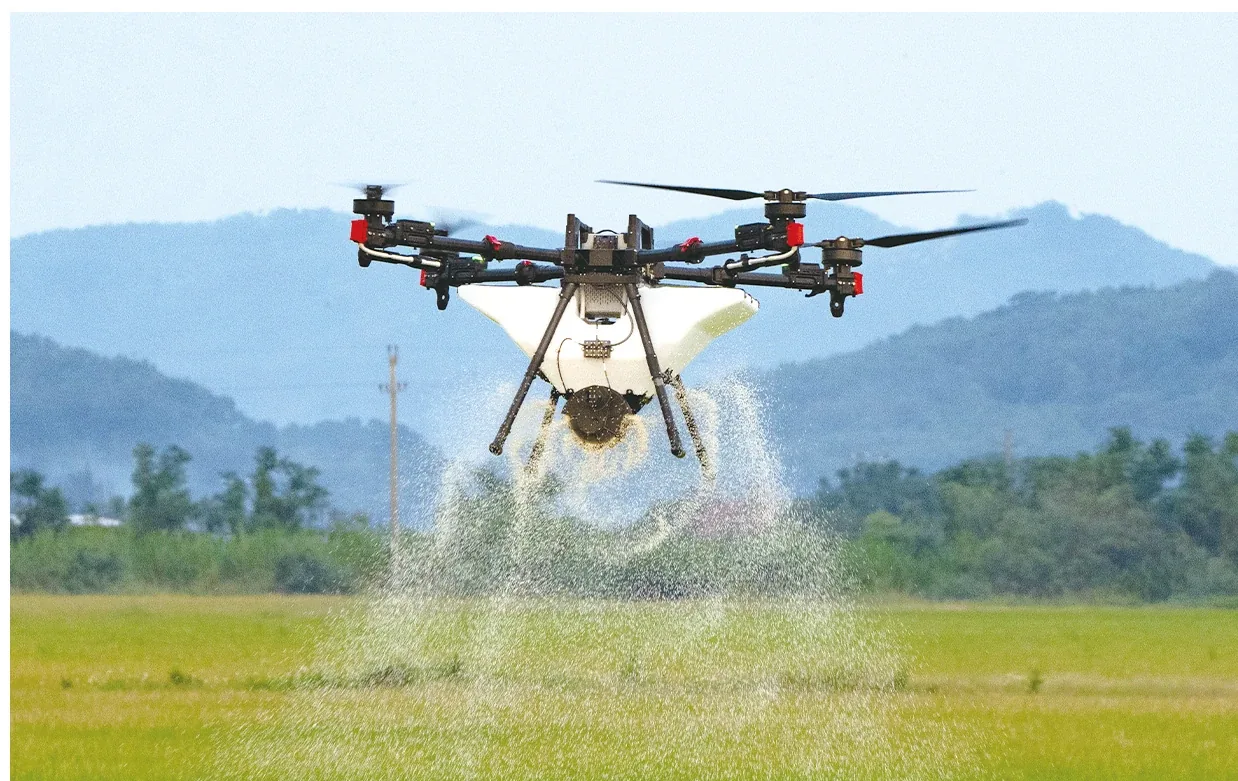
Use swath × speed as a planning starting point, then measure on your block.
A simple planning formula is: effective swath × speed × 0.36 = theoretical hectares per hour, before turns, refills and battery swaps. Real output is lower; use the formula as a starting point, then measure on your block.
Example: a 6 m effective swath at 6 m/s gives about 13 ha/h theoretical. After turns and refills, the real figure may be half or less depending on block shape and logistics.
The formula is a planning aid, not a performance guarantee. Confirm with a field demonstration on your crop and terrain.
Comparison
Spraying drone or tractor: which fits?
| Consideration | Spraying drone | Tractor / manual |
|---|---|---|
| Soil compaction | None | Wheel traffic and compaction |
| Wet-field access | Can work when ground is soft | Limited by field trafficability |
| Water volume | Low-volume application | Higher water volumes typical |
| Canopy coverage | Airflow-assisted from above | Boom height and nozzle dependent |
| Labour | Pilot and spotter | Driver, operator or crew |
| Timing | Fast deployment on small windows | Weather and field access dependent |
Configuration
What should you specify?
Specify the crop, canopy, product, water volume, block size and wind conditions. The configuration should then set the tank, nozzle, flow, speed and swath — not the other way around.
- Tank size and refill distance.
- Nozzle set and droplet range for the product and canopy.
- Flow rate and swath for the target water volume.
- RTK source and obstacle mapping.
- Battery count, charger and daily rotation.
- PPE, cleaning and product-handling plan.
Maintenance
What maintenance does it need?
Application setup and cleaning routine are part of operator training.
Chemical residue and nozzle wear change the spray pattern. Build a cleaning routine after each product and check nozzles, filters and pump seals on a schedule.
Spare nozzles, filters and seals should be part of the initial order, not an afterthought in the busy season.
FAQ
Questions buyers ask
How does a spraying drone work?
A pump moves product from the tank to nozzles; the nozzle and pressure set the droplet size, and rotor airflow helps carry droplets into the canopy. RTK guidance keeps the passes repeatable.
How many hectares per hour can a spraying drone cover?
Theoretical coverage is effective swath × speed × 0.36. Real output is lower after turns, refills and battery swaps. Measure on your block; do not rely on a published maximum.
What is the payload and tank capacity?
The XAG P150 has a 70 L liquid tank and 70 kg maximum payload. P60 tank and payload are configured for your market because the compact platform is specified to the market.
How long is the flight time?
Flight time depends on payload, speed, wind and battery condition. Plan by task: how many hectares per battery, how long a refill takes, and how many packs you need for a working day.
How many batteries do I need per day?
Battery count follows daily hectares, pack capacity, charging time and whether you charge in the field. The configuration and quotation include a rotation plan.
Can it spray without RTK?
Yes, but accuracy drops to metre level and overlap increases. RTK is recommended for narrow rows, orchards and repeatable application.
What crops can it spray?
Rice, sugarcane, oil palm, orchards, vineyards, cotton, wheat, corn, soybean and vegetables are common. The nozzle, droplet size and rate must match the crop and product label.
What maintenance does it need?
Clean the tank, lines and nozzles after each product; check filters, pump seals and nozzle wear; inspect props and radar; and keep a spare-parts kit for the season.
Is drone spraying legal?
It depends on the country and the product. Registration, operator certification and aerial application approvals may apply. Confirm with the local authority before operation.
Next step
Spray the block, not the spec sheet.
Send the crop, canopy, water volume, block size and country. We will propose a nozzle, flow, speed and tank configuration.